


A proud history of infrastructure work; Wilson and Dickson look back on water and sewer project
On Wednesday, Oct. 8, a Wilson Brothers Construction crew prepared to place the last pipe in the ground on Main Street in Lovell – the last of thousands in recent years.
[caption id="attachment_9214" align="alignright" width="189"]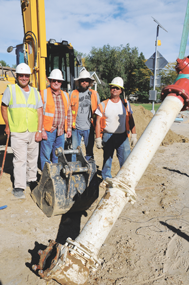 Posing with the last fire hydrant for the Lovell water and sewer infrastructure project (with connecting stem to the water main) are (l-r) Lovell councilman and water commissioner Brian Dickson, project supt. Kim Wilson, foreman Michael Wilson and operator Mike Alcarez, all of whom have worked on the final four phases of the massive project. In the cab of the backhoe is Jason Brothers.
David Peck photo[/caption]
In this case, it was the final new fire hydrant for Main Street, the last connection to Lovell’s water and sewer system that has been almost completely rebuilt over the last 10 years.
There’s still work to be done including some concrete work, cleanup and the punch list, but for the most part, the fifth and final phase of the Lovell water and sewer infrastructure project is complete, the last four done by Wilson Brothers.
After the difficulties of the North Project in 2006-07, the final four phases of the project have run smoothly with the experienced Wilson Brothers at the helm, as the project added four more chapters to the storied history of the Cowley company.
Wilson was hired to step in and finish the North phase in 2007, then won bids for the next four phases of the project: Southeast in 2008, Southwest/Transmission Line in 2009-10, South in 2011-12 and Main Street in 2014, the final phase as the water and sewer subcontractor working with WyDOT street repair general contractor Reiman Construction.
During the eight years, according to Wilson Brothers co-owner Kim Wilson, there are four workers who have worked on all phases of the project: operator Mike Alcarez, lead foreman Jason Coble, foreman Michael Wilson and operator/trench foreman Kevin Gordon. Kim Wilson has been the superintendent of the four phases, with Lane Denzin as project coordinator, Deb Nordenstam in the company office and Lovell Town Manager Brian Dickson overseeing the project for the Town of Lovell as water commissioner.
Looking back at the project, Kim Wilson noted that his nephew Michael Wilson is part of the fifth generation of the Wilson Brothers history, and Michael’s son Jessee, who works during the summer when not attending the University of Wyoming, is the sixth generation.
Wilson Brothers Construction was formed in 1999, spinning off of CA Wilson Construction after Charles A. “Chick” Wilson died. His sons Boyd, Wes, Kim and John formed the new company. And now Boyd’s son Michael, Wes’s son Danny and Kim’s sons Nick and Jeff are carrying on the family business.
The first generation was George B. Wilson, who helped build the Sidon Canal and the railroad grade through Pryor Gap around 1900. George’s son Ray Wilson was part owner of Wilson-Welch Construction, and son Chick Wilson formed CA Wilson Construction.
A great experience
Kim Wilson said working in Lovell on the four phases of the water and sewer project has been a wonderful experience.
“The people of Lovell are great to work with,” he said. “We’ve had very little trouble from the people, and we’ve terrorized them, because we go by (a house or business) twice. The sewer line is laid first, then the water line. They can’t be in the same trench together, and the sewer has to be set on grade.
“It’s been a wonderful experience for Wilson Brothers working with the people, and the town has been great to work with.”
Kim said the company’s variety of experience has paid off over the years. The company started with building logging roads in South Dakota, he said, and keystone retaining walls along the Snake River between Alpine and Hoback Junction.
“We have so much experience,” he said. “We’ve been doing this for 35 years. That’s the difference. We were raised on a scraper and dozer doing land leveling for Dad.”
It’s been a pleasure to work locally, Kim said. Not only are the people patient, they are often kind.
“How many widows have brought you donuts,” Councilman Dickson asked with a smile. And Wilson recalled United Methodist Pastor Paula Morse bringing lemonade to the hot and tired workers. Jerry Warman has brought workers many cases of water over the years, and has also helped with cleanup.
“They may not always understand, but they’re agreeable,” Wilson said of the residents.
Doing work locally is a benefit in many ways, Wilson added. Not only is a local project cheaper to bid, the workers enjoy the luxury of a short drive to go home at the end of the day, with the vast majority of workers hired locally. He said there are normally around 20 workers on a given job, “and it all stays right here,” he added.
Unearthing history
Digging up the streets of Lovell has been a bit like looking back in time, Wilson and Dickson said. The first water lines installed around 100 years ago were wooden pipe with wire wrapped around the pipe. Next came steel pipe. Neither has been in use for many years, but workers have found remnants of the old pipes.
Ductile iron was used from the 1960s on, and a lot of the pipe was still in use when the project started. PVC is the standard now.
The problem with ductile iron pipe is that it is eaten up by the soil chemistry, Dickson said, forming huge holes in the mains.
“We’ve found big holes (in the mains) in all phases of the project,” Wilson said. “The only thing that kept it together was mud. That kept it from blowing out, but it has leaked.”
“It starts rusting in place (due to the soil),” Dickson added. “It holds water until the pressure changes.”
“When you dig it up the rust just falls out and there’s a big hole left,” noted Wilson.
As for the sewer, tile has been the standard for decades, starting in about the 1930s, and some of the service lines were cast iron. Now, the tile is being replaced by PVC.
“The tile was good stuff and would still be here today if it had good rubber in the joints and if the ground wasn’t heaving,” Wilson said. “There’s nothing wrong with the tile, except that it gets roots in it and loses its seals.”
Pride in the project
Now that the project is wrapping up, both Wilson and Dickson can look back on the infrastructure project with pride.
“Think of all the services you’ve installed,” Dickson said to Wilson, noting that there are about 1,200 water taps in town, each with a service line and most worked on by Wilson Brothers.
“What’s so amazing about it to me is that Lovell is the only town in Wyoming with a totally new water and sewer system, and they did it in 10 years, which is really, really something,” Wilson said. “Other towns are piecemealing it, and every year that goes by, the more expensive it gets.”
Wilson noted the foresight of the Town of Lovell, and Dickson said that, while Lovell’s rates have been considerably higher than other towns to pay for the project, other towns’ rates are climbing. When he surveyed rates a few years ago, he said he was told, “Yours are right where the other towns are going to be when they do their projects (later).”
By David Peck
307-548-2217 | 234 E. Main St. Lovell, Wy 82431
