


State, local officials seek compromise on armory
It’s one of those good news/bad news situations, and it may take seven years or longer to implement, but the Lovell community could eventually lose its Wyoming National Guard armory but at the same time maintain the field maintenance shop that currently employs six full-time workers.[caption id="attachment_6330" align="alignleft" width="287"]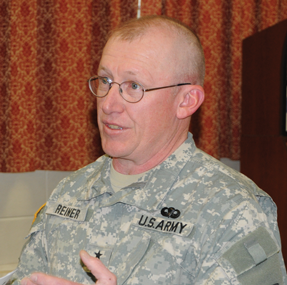 Wyoming Adjutant General Luke Reiner makes a point during a meeting with Lovell community leaders Friday morning.[/caption]That was the word from Wyoming Adjutant General Luke Reiner during a meeting with Lovell community leaders Friday morning at the armory in Lovell.Reiner’s meeting came after nearly a year of fact-finding that followed a similar gathering of community leaders in June of 2012, beginning a process precipitated by a decision by the Wyoming Legislature to “study the status and condition of armories in the Big Horn Basin and consider the potential reorganization of those armories.”“There will be no decision today,” Reiner said Friday. “I want to make sure we have understood the facts correctly. I’m looking for consensus from you to get legislative support for the road ahead.”Reiner said he must brief the Joint Transportation, Highways and Military Affairs Committee on June 10.The Big Horn Basin currently has four armories and one field maintenance shop: armories in Cody, Powell, Worland and Lovell and the shop in Lovell. Reiner said the eventual goal is to reduce the facilities to two armories and one maintenance shop.It will be a long process of planning and construction and/or remodeling, he said.“The time lines are long in this process,” the general said. “What we’re talking about today may come to fruition by 2020. But we need to know what direction we’re heading.”Having four armories “clumped together” in the Basin are simply too many given the current personnel numbers and the ability to budget for maintenance, Reiner said. After last summer’s meetings in the Basin he asked his staff to assess the status of the facilities and the costs of moving forward under various scenarios, considering factors like construction, remodeling and maintenance costs, safety, travel, carrying capacity and recruiting.“We want to maximize the number of counties we’re in while minimizing costs,” he said. “We want to maximize our presence across the state.”After presenting demographic information, Reiner assessed each Guard facility in the Basin as follows:Cody Armory: Untenable (FAA waiver currently in effect);Powell Armory: Good location, but a little small;Worland Armory: Very small and wrong location but with a legislative mandated and funded study to explore moving the armory;Lovell Armory: Old, very small;Lovell FMS: Too small for equipment (dangerously small).After presenting other factors, Reiner presented the following construction costs:Powell remodel: $4.05 million in state funds, $4.05 million in federal funds -- $8.1 million total;Lovell new FMS: Zero state funds, $15.1 million federal funds, $15.1 million total;Worland new armory: $5.1 million in state funds, $16.5 million in federal funds, $21.6 million total;Worland new armory and FMS: $4.1 million in state funds, $25.9 million in federal funds, $30 million total.Courses of actionReiner presented two possible courses of action, in no particular order: 1) Remodel the Powell armory and build a new armory and maintenance shop in Worland, total cost $38.1 million, a decision which would pull the National Guard out of Big Horn County; or 2) remodel the Powell armory, build a new armory in Worland and build a new maintenance shop in Lovell, total cost $44.8 million, a decision which would keep the Guard in all three counties.Renovating the Cody armory isn’t an option because the current facility rests in a restricted air space area near Yellowstone Regional Airport, Reiner said. He also said he threw out an option of building one large armory in a central location like Greybull, saying the Guard is community based and it’s good to have multiple facilities for disaster response.Reiner said he cannot justify the cost of remodeling three or four armories in the Basin.“It makes sense to me to have one in the north and one in the south (portion of the Basin),” Reiner said, adding, “I’m pretty sure we’re not going to put a new armory in Cody. We have a good armory in Powell that can be renovated and modernized for about $8 million.”Looking at the two courses of action under consideration, Reiner said consolidating facilities in Powell and Worland (#1) would be fiscally beneficial, but citing Lovell’s long and dedicated support to the National Guard, he said the second option makes sense to him.“As I compare the two, obviously number one is better in terms of cost, but it does not meet my criteria of maximizing the number of communities and counties in the Big Horn Basin,” Reiner said. “Number two keeps us in more communities and, importantly, keeps us in Lovell. My preferred course of action is number two.”DiscussionDuring the discussion that followed, Rep. Elaine Harvey questioned figures Reiner presented stating that the Lovell community averaged only two annual enlistments compared to three for Cody and Worland and four for Powell, noting that recruiting numbers have a lot to do with the recruiter working in the area and that when Bruce Jolley was the recruiter enlistments from Lovell were much higher. Even with the lower numbers presented Friday, Lovell’s enlistments are higher than the other communities on a per capita basis, Harvey said.“As I look at the numbers, it makes me miss Bruce as a recruiter,” she said. “He had considerably more than two enlistments per year.”Former guardsman Rich Fink agreed, noting that Jolley was at almost all of the local student activities but the most recent recruiter was rarely seen. Reiner said a new recruiter recently assigned -- Sgt. Mike Poole – will be much better, adding, “I have a lot of faith in him.”“Bruce was at every function that included students,” Harvey said. “They looked at him with respect as a leader and a friend. They looked to him and they knew they had someone to turn to.”But Jolley echoed Reiner, saying, “I think Sgt. Poole will do a good job.”Harvey also expressed disappointment that Lovell wouldn’t be considered for a full armory under the scenarios presented, noting the community’s support for the Guard over the years.Reiner said he understood the concern but said given the fiscal impact of the decision and his desire for “geographic dispersion,” a new armory in Lovell compared to remodeling an armory in Powell at less than half the cost didn’t score as well in the Guard’s analysis.He said the Guard did consider a new armory and shop in Lovell but added, “I’d like to stay in as many counties as we can.”Would an uptick in enlistments from Lovell change the course of action in a multi-million-dollar decision?“I’m not sure it does (change the course),” Reiner said. “We’re asking people to drive either way. It’s the way we’ve gone. It’s the shrinking of the footprint of the Guard. I would love to see more recruiting in Lovell. I’m not sure it would change the course of action. Cost and staying in multiple communities, that was my priority.”Asked about the future of the Lovell armory building if the armory eventually closes, Reiner said it could be given to the town or county or it could be razed for the purpose of building a new shop within the building’s footprint.Reiner said that, with a new maintenance shop, maintenance drills would continue to be held in Lovell, noting, “I don’t expect that to change.” And he added, “Until something is built, I don’t see any changes over the next 10 years.”“I do need to give you a better shop, a better place to maintain vehicles,” he said, adding that a new shop would be much larger and would continue to employ six full-time people.” An armory has only two full-time people, he said.A greater concern, most in the room agreed, was the interaction between the National Guard and the public. Fink said it is difficult to maintain community support for the Guard by closing armories, and Reiner agreed, noting, “That’s why we want a presence in every community. We need a presence in Lovell because of the great support in Lovell.”Fink said he gets a lot of calls from people with questions, even though he is retired from the Guard. He asked if the armory could be staffed even one or two days a week. He said it is difficult for people to work with the Guard at the state level and asked if more decisions could be made at the local/unit level, adding, “It’s bogging us down.”Harvey said she has seen a decline in support from the Guard to the community over the years. “It’s hard to even get a color guard for the parade or a firing squad for Memorial Day services,” she said. “Now if you remove facilities you will remove motivation to support the Guard.”“We have to have community support,” Reiner said. “I’m looking at lots of communities and I’m looking at Lovell. We need to stay in Lovell, and I’ve had no pushback (within the Guard) on that.”“Speaking for the town, we don’t want you to go,” Councilman Brian Dickson said. “I don’t think you can quantify community support.”“Really, it’s a culture,” Harvey added.“Our challenge is to not lose that culture,” Reiner responded. “We will still have six full-time people here. It’s not only Lovell, it’s across the board. We’ve even put it in our strategic plan to maintain our heritage and our history. It’s slipping away and it scares me.”Both current Guardsman Rich King and former Guardsman Terry Wilkerson said the National Guard is taking on a much greater role nationally as part of the defense force, and soldiers are stretched thin when it comes to extra duties.Former career Guardsman Scott Fink noted that the rules have changed and they are “not Luke Reiner rules.” He said he and Rich Fink could once simply put up a tent for Mustang Days. Now it takes a lawyer to set up a tent.“I’m disappointed, too,” he said. “I grew up in this armory, but reality is reality. There are fiscal constraints.”“My goal is to not close any armories,” Reiner said. “The reality is I don’t know what else to do.”County Commissioner John Hyde said he understands and appreciates Reiner’s support for a presence in Lovell but said, “I’m worried about the next guy. What happens down the road?”Reiner said whoever succeeds him is probably already on his staff and promised to “lock it in” – meaning the field maintenance shop.“We don’t want to lose the Guard presence in Lovell,” Rich Fink said. “If I have to choose, it’s number two.”“I really appreciate your commitment to locking it in,” Commissioner Keith Grant added.Reiner said he is willing to push for course of action two – which includes the new shop in Lovell – before the Military/Transportation Committee next week and asked if he could get the Lovell group’s support for that position.Harvey talked with emotion about what it means to have the strong Guard presence in the community and the pride of having so many soldiers serve their country, saying the Guard plays an important role in the culture of the X-Box generation.“You’ve got to have a positive role model,” she said. “You’ve got to have the people who bring that pride. That’s why I want an armory here.”“I would say our goals are exactly the same,” Reiner said. “I want the same thing for Lovell that you do. It’s not about a building, it’s about the people who serve us. The building may change, but the culture will not change.”Reiner said there would not be a kitchen in a maintenance shop, but he said lockers could be installed so drill could be held in all three remaining communities in the Basin.“So we’re stuck with number two?” Harvey asked.“That’s pretty much where we’re at,” Reiner replied.“I’d trade it (the armory) for more presence of the Guard in the community,” Harvey said, “more people in uniform doing things.”By David Peck
307-548-2217 | 234 E. Main St. Lovell, Wy 82431
