


North Big Horn Senior Citizens Center | Guiding seniors into an information age
As senior citizens cross the threshold of time, they are bombarded with an increasing amount of confusing information that is critical to making many important life decisions. North Big Horn Senior Citizens Center Director Denise Andersen and her staff make it their mission to help seniors sort through that information and to take as much “fear” out of those decisions as possible.Phrases like, “It’s open enrollment time, have you checked your drug formulary to see if your drugs are a Tier 1 or a Tier 2?” are more common than not and are baffling at best. Andersen said it’s become a fairly routine part of her job to guide members through the quagmire of information about Medicare, Social Security benefit strategies, issues connected with health and aging. She said her mission is to help Center members understand the information that is available in order to make their own informed decisions.Andersen said Medicare is particularly complex, with terms that have no meaning at first but require immediate action. She said it’s not uncommon for senior citizens to come into her office with a stack of paperwork they don’t understand, expressing anxiety about deciphering its meaning.“Most people don’t have any idea what their Medicare coverage is until they try to use it,” said Andersen. “Dealing with Medicare is like learning a new language and learning this new language becomes incredibly important not only for people’s health but also for their pocketbooks. I think this is one of the largest hurdles we face here in the senior center world, trying to help people understand this new language and to understand the mountains of paperwork that go with it, especially when it comes to Medicare and Medicaid.”Andersen described the terminology of Medicare as a “new language.” She added that not knowing the language is very intimidating to many of the people she works with.[caption id="attachment_11774" align="alignright" width="285"]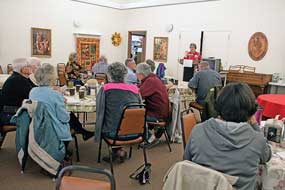 AARP volunteer Barbara Gast teaches a defensive driving course to senior citizens on Monday at the North Big Horn Senior Citizens Center in Lovell.
Patti Carpenter photo[/caption]“That language is so out there, it makes you just shake your head and most people don’t even know where to begin,” she said. “This is a language that seniors don’t speak, making this part of the aging process a difficult part. For many seniors, it is also a scary part and a most frustrating part of aging. Suddenly you’re thrust into a situation where you need to make decisions and they are important ones, too. It’s very confusing, especially when you don’t understand the terminology you’re using to make those decisions.”In addition to one-on-one help navigating the health care system available to members, the Center also offers a number of life skills classes like defensive driving for aging drivers, general nutrition classes and diabetic empowerment courses, along with presentations about hearing loss, how assisted living works and other topics of interest to senior citizens.Andersen is a Wyoming State Health Insurance Information Program (WSHIIP) volunteer with special training and access to resources that help her explain Medicare related information and subsidies that may be available to low income seniors. Approximately 25 percent of the Center’s clientele live below the poverty level, making them eligible for subsidies and other special services.“Every state has a SHIIP program,” explained Andersen. “In Wyoming it’s called WSHIIP. The program is a national network of volunteers that try to help on a local level. I feel privileged to be a WSHIIP volunteer.”She said the Center partners with the County Health Department and North Big Horn Hospital to provide health related information to its members. Many of the classes are offered free of charge or at very low cost.“Each person is very individual, so classes can help to a certain extent, but individual attention is also very important,” said Andersen. “Even a couple can have completely separate needs.“Economics plays a huge role, and different people have different needs. So independent, one-on-one help is pretty important.”Andersen said she is available to center members to help with any issues of concern. She said often it’s as simple as helping someone fill out an application or sorting through information online to determine what is legitimate and what is a scam or learning how to use a new cellphone.“I never believe for a minute that I know all the answers, but if I don’t know the answer, I make it my goal to find it,” she said. “I think my staff feels that same way, too. We all want to help and we will do whatever we can to that end. I also see our members helping each other all the time. I think swapping experiences with like-minded people in the same age group or economic situation is very beneficial, too.”
By Patti Carpenter
307-548-2217 | 234 E. Main St. Lovell, Wy 82431
